

In southeastern North Carolina, strengthening the healthcare workforce is also a strategy for long-term economic growth. At Cape Fear Valley Health System, expanded physician training has helped address provider shortages while generating significant economic impact across the region.
“Developing a physician workforce here in southeastern North Carolina is core to what we do,” said Cape Fear Valley Health System’s Chief Executive Officer Mike Nagowski. “By every statistic you look at, we have a dramatic shortage of healthcare providers in this region.”
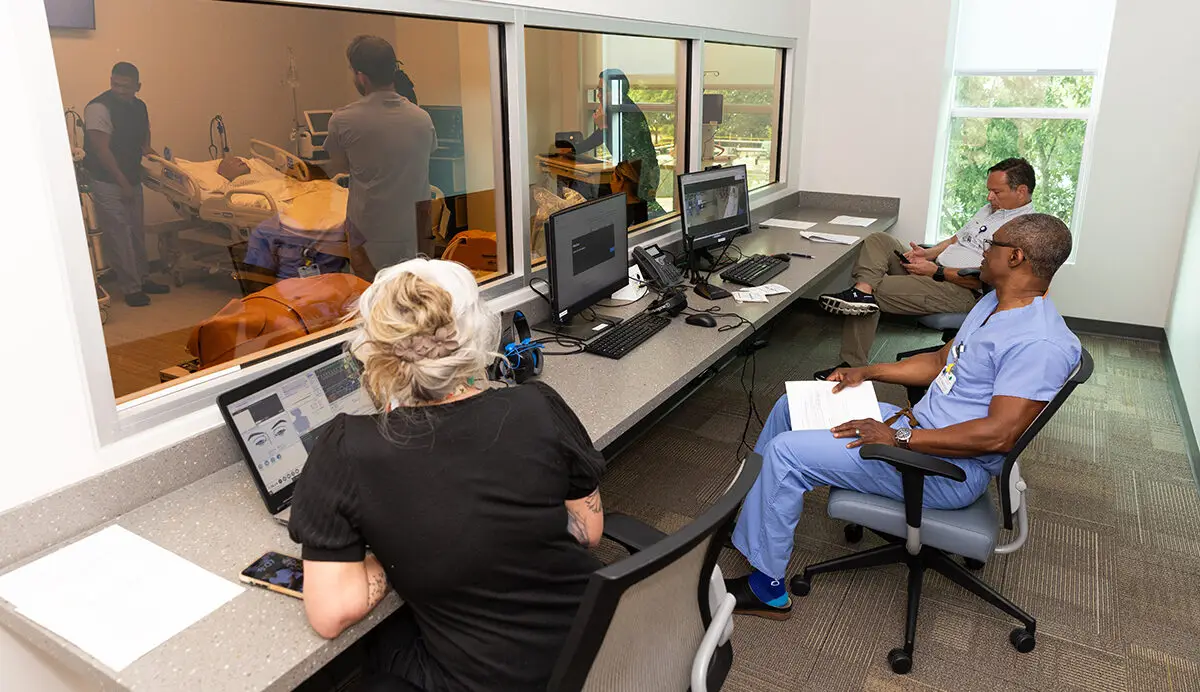
That need led to the expansion of Cape Fear Valley’s Physician Residency Program, which launched in 2017 with 51 residents and has grown to more than 330 physicians in training today.
In 2020, the Golden LEAF Board of Directors awarded $461,200 to support the Health Care System’s Center for Medical Education and Research that is located at Cape Fear Valley Medical Center. Funding supported advanced instructional technology in the Center’s auditorium, creating a modern, flexible learning environment for resident training and distance learning. Cape Fear Valley Health Care System serves Bladen, Columbus, Cumberland, Harnett, Hoke, Robeson, Sampson, and Scotland counties.
“We grow every year,” Nagowski said. “And that growth directly translates into impact for this region.”
Nagowski shared that Cape Fear Valley’s numbers support what studies show about physicians practicing, where they had their residencies.
“The data is pretty clear,” Nagowski said. “Where physicians do their training is perhaps the most significant factor in where they settle down to practice. Nearly 60 percent of Cape Fear Valley residency graduates have remained in the region.”
Those physicians have a multiplier effect on the economy.
“When we hire a physician, all the jobs that support that doctor come with the position, including nurses, front desk staff, radiology, administrative roles,” Nagowski said.
Golden LEAF funding extends beyond physician training to the broader healthcare workforce in the region. Golden LEAF has invested in several healthcare workforce programs at community colleges including Fayetteville Technical Community College, Bladen Community College, and Sampson Community College, all who are key partners in training nurses, technicians, and allied health professionals.
Golden LEAF also supported Fayetteville State University’s nursing program. In 2018, the Golden LEAF Board awarded $134,200 for additional software and training equipment to support program growth and provide simulated health scenarios. Many of these graduates also stay in the region to live and work.
“If it was not for the growth and expansion of community college and other healthcare training programs in the Southeast, we would be in a world of hurt,” Nagowski said.
Now, that workforce pipeline now reaches all the way to medical school.
“We are incredibly proud of the quality of our residents,” said Nagowski. “Their test scores exceed national averages, which is remarkable for a relatively young program. That success has also fueled further growth, including the launch of the nation’s newest Doctor of Medicine medical school.”
In July 2026, the Methodist University–Cape Fear Valley School of Medicine will welcome its inaugural class of medical students. The Golden LEAF Board awarded $8 million to Methodist University for instructional equipment that, at full enrollment, will support enrollment of 480 students with 120 graduates each year. It is expected that 60 of those graduates will complete residencies in the Cape Fear Valley Health System.
“Ten years ago, the idea that we’d be training this many residents and launching a medical school, people wouldn’t have believed it,” Nagowski said. “The success of our residency programs and the support of partners like Golden LEAF made it possible.”
Together, these investments demonstrate how healthcare workforce development strengthens communities, improves access to care, and drives lasting economic opportunity across southeastern North Carolina.