

Access to quality healthcare is an important part of economic development, helping communities attract businesses, support a healthy workforce, and create opportunities for long-term growth. In rural North Carolina, physician shortages can present challenges not only for residents seeking care but also for communities working to strengthen their economies.
The new Methodist University Cape Fear Valley Health School of Medicine in Fayetteville aims to address these challenges by preparing future physicians and creating pathways for them to practice in southeastern North Carolina.
“When companies are looking to locate in new areas, they often ask two questions: Is there going to be good education for the children of our employees? And is there going to be good healthcare for our employees and their families?” said Dr. Hershey Bell, Dean of the Methodist University Cape Fear Valley Health School of Medicine. “When you put a medical school into a community and you start to grow access to healthcare and healthcare services, more and more businesses want to come to that community.”
In August 2024, the Golden LEAF Board of Directors awarded $8 million to Methodist University to support instructional equipment and two mobile health clinics for the new medical school. The school welcomed its inaugural class of 64 students in 2026, marking a major milestone for an effort that began in 2019.
“To have the students arrive in 2026 and really light up the building was phenomenal,” said Dr. Bell. “The building came alive once the students entered it. It was a great moment and a great sense of achievement and pride for the whole community.”
Addressing rural healthcare challenges
Cape Fear Valley Health serves eight counties, including Bladen, Columbus, Cumberland, Harnett, Hoke, Robeson, Sampson, and Scotland, many of which face substantial healthcare disparities.
“We exist because we live in a healthcare desert,” said Dr. Bell. “In our region in southeastern North Carolina, every county has less than half the number of physicians it needs.”
The medical school’s mission goes beyond educating physicians to preparing professionals who understand the communities they serve, including barriers related to housing, food insecurity, and access to medical services.
“I tell students during interviews that the easiest thing to learn in medical school is medicine,” said Dr. Bell. “The hardest thing to learn is how to make it work so that people actually experience the outcomes.”
Through two mobile health clinics supported by Golden LEAF funding, students will work under faculty supervision to provide healthcare services in underserved communities while gaining firsthand experience with the challenges rural residents face.
“They’re going to first of all see what these communities are like and start to understand where people live and how that impacts their healthcare,” said Dr. Bell. “It’s not just simply delivering healthcare, treating hypertension, or delivering preventive care. It’s really understanding the ecosystem in which healthcare needs to be delivered.”
Building a regional physician workforce
In April 2020, the Golden LEAF Board awarded $461,200 to Cumberland County Hospital System, Inc. for technology in the main lecture auditorium of the new Center for Medical Education and Research adjacent to Cape Fear Valley Medical Center. The center was developed to expand physician residency training, building on research indicating that more than half of physicians establish practices within 50 miles of where they complete their residencies.
The new medical school builds on that foundation by creating a pathway for students to complete medical education and residency training within the region.
At full enrollment, the school is expected to serve 480 students and graduate 120 annually. Approximately 60 graduates each year are expected to complete residency training through Cape Fear Valley Health, with an estimated 40 remaining to practice in the region.
“What the Association of American Medical Colleges statistics show is that if a medical student graduates from a school and completes residency in the same region, there’s a 70% likelihood they will remain as a physician in that region,” said Dr. Bell.
Throughout their education, students will also train in rural healthcare settings, gaining experience with the communities they may eventually serve.
Preparing physicians through innovative technology
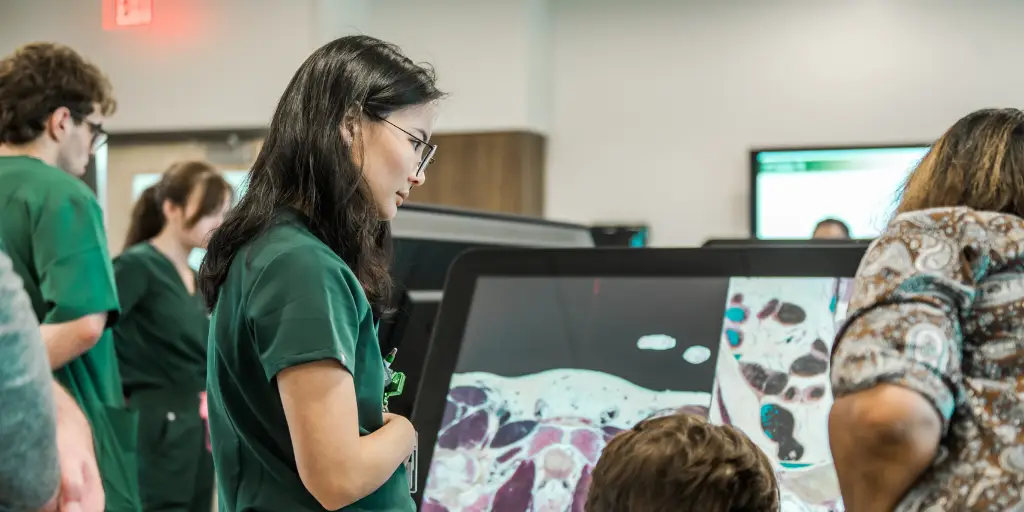
Golden LEAF funding also supports advanced instructional technology in the school’s new five-story, 125,000-square-foot facility, allowing students to learn through simulation and interactive experiences.
Dr. Bell said the technology provides opportunities to explore variations in anatomy, examine the effects of diseases, and study relationships among different body systems.
“When I went to medical school in the late 1970s, we had a cadaver that we dissected,” said Dr. Bell. “But it was one cadaver that presented one vision of what anatomy looked like. With this equipment, we can separate out the nervous system from the musculoskeletal system, from the lymphatic system, and they can start to see relationships in ways that you can only see through technology.”
These tools help students develop a deeper understanding of the human body and prepare for the complexities of patient care.
Strengthening communities through healthcare access
The medical school is already attracting faculty, staff, and practicing physicians from across the country who want to contribute to its mission.
“People want to come here to southeastern North Carolina because they believe in the mission, they believe in the vision, and they want to be part of this,” said Dr. Bell.
As the school grows, Dr. Bell hopes communities throughout southeastern North Carolina will see it as a resource that belongs to the entire region.
“My hope is, and it’s already starting to happen, that the communities will see this as their medical school,” said Dr. Bell. “It’s not a medical school that happens to be in southeastern North Carolina. It’s southeastern North Carolina’s medical school.”
Together, Golden LEAF’s investments in residency training and medical education are helping create a pipeline of physicians who can serve rural communities, strengthening a critical component of the region’s economic future.