

What does it take to keep North Carolina agriculture competitive in a rapidly changing world?
Today’s farmers face complex challenges that require more than traditional solutions. The Plant Sciences Initiative (PSI) at NC State University was created to meet that challenge by bringing together researchers, farmers, industry leaders, and government partners to solve real problems and deliver practical innovations to the field.
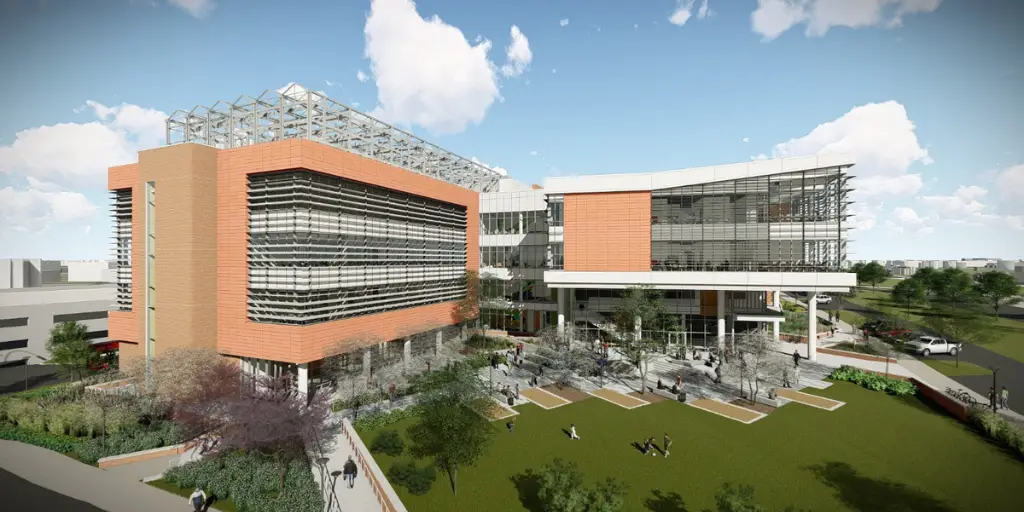
The Golden LEAF Board of Directors awarded $48.5 million to support the design and construction of the PSI building. The PSI serves as a hub for cutting-edge research, technology development, and workforce training. The initiative is designed to connect research and development to impact by ensuring that discoveries don’t stay in the lab, but reach the farmers and agribusiness professionals in North Carolina and beyond that can use that information in the field.
At its core, PSI focuses on four key areas shaping the future of agriculture: improving crop resilience, advancing digital agriculture tools, strengthening sustainable production systems, and preparing the next generation of agricultural leaders. By combining expertise across disciplines and working directly with farmers, PSI is accelerating the pace at which new solutions are developed, tested, and adopted.
This collaborative, public–private model is also driving economic growth by supporting new startup companies, attracting industry investment, and positioning North Carolina as a national leader in agricultural innovation.
The impact of this work is already being seen across the state. From protecting a billion-dollar sweetpotato industry to launching new ag-tech companies and equipping farmers with data-driven tools, PSI is helping ensure agriculture remains productive, profitable, and sustainable for generations to come.
The following case studies highlight how the PSI is delivering real results where it matters most, in the field and through agribusinesses that affect rural communities across North Carolina.
Future-Proofing a Billion-Dollar Crop: The Covington Sweetpotato
For 20 years, NC State’s Covington sweetpotato has been the backbone of North Carolina’s sweetpotato industry. This crop now accounts for about 90% of the state’s production and generating an estimated $5 billion in value. Its consistent yields, quality, and storage life helped position North Carolina as the nation’s leading producer and a global exporter.
That success is at risk from emerging threats like guava root-knot nematodes, a microscopic roundworm that attacks both fibrous and storage roots in sweetpotatoes, which can significantly reduce yields. Through the PSI researchers are combining advanced breeding and genome editing to develop a new generation of Covington with built-in resistance. This approach could cut development time in half while preserving the traits growers depend on.
Impact: The PSI is helping protect one of North Carolina’s most valuable crops by accelerating the development of resilient varieties that keep farmers productive and competitive. Since 2016, 250 new plant varieties have been developed by PSI for commercialization.

Growing Agricultural Innovation: One Startup at a Time
Turning agricultural research into real-world solutions takes more than discovery, it requires the right support to bring ideas to market. Through the PSI’s Seed2Grow program, entrepreneurs are able to transform plant science innovations into new agricultural technologies and businesses.
Seed2Grow provides startups with access to specialized labs, mentorship from industry leaders, and connections to investors and partners, all within the Plant Sciences Building. In just its first year, the program launched an ag-tech incubator, supported multiple startup companies, and built a pipeline of new ventures. One standout success is Hoofprint Biome, a company developing feed additives that reduce methane emissions from cattle while improving productivity. In 2025, the company raised more than $15 million in private investment and became the first to graduate from the Seed2Grow program.
By combining university research, industry expertise, and entrepreneurial support, Seed2Grow is helping accelerate the development of technologies that address challenges in food production, sustainability, and global agriculture.
Impact: The PSI is helping drive economic growth by supporting ag-tech startups, accelerating technologies to commercialization, and positioning North Carolina as a leader in agricultural innovation. PSI reports that over five years, 399 new plant sciences private sector companies were created in North Carolina.
From Data to Decisions: Smarter Soybean Planting
For North Carolina’s more than 5,000 soybean growers, knowing when and what to plant can make a significant difference in yield and profitability. But with varying climates across the state, one-size-fits-all recommendations often fall short. To address this, researchers through the PSI developed BeanPACK, a free, web-based decision tool that delivers site-specific planting recommendations.
Built using thousands of data points from five years of field trials across 20 locations, BeanPACK allows farmers to input their region and receive tailored guidance on optimal planting dates and maturity groups. The tool was developed through a highly collaborative effort involving researchers, data scientists, Extension agents, and growers, and was refined through on-farm testing and user feedback. By translating complex research into an easy-to-use digital platform, BeanPACK helps farmers reduce risk, improve yields, and make more informed decisions.
Impact: The PSI is helping deliver practical, data-driven tools like BeanPACK that improve farm productivity, reduce uncertainty, and support the long-term success of North Carolina agriculture. Since 2016, 184 new PSI technologies have been developed.
Building the Next Generation of Agricultural Leaders: Rural Internship
Preparing a skilled workforce is essential to the future of North Carolina agriculture. Through a partnership between NC State Extension and the PSI, students are gaining hands-on experience working on real-world agricultural challenges in rural communities.
One example is NC State student Nathaniel Rhein, who participated in a summer internship focused on phosphorus sustainability. This important issue is tied to soil health, crop productivity, and environmental resilience. Working across 10 counties, Rhein collected soil samples, helped map nutrient flows, and collaborated with extension agents and researchers to better understand how events like flooding impact agricultural systems. He also gained experience in pest detection and agricultural outreach, including work with local farms and youth programs.
By combining classroom learning with field-based research and Extension engagement, the program gives students practical skills while directly supporting farmers and communities.
Impact: The PSI is helping build a strong agricultural workforce by providing hands-on training opportunities that prepare students to address real challenges in North Carolina’s farming communities. In 2021, North Carolina had 43,210 people employed in plant sciences jobs.