

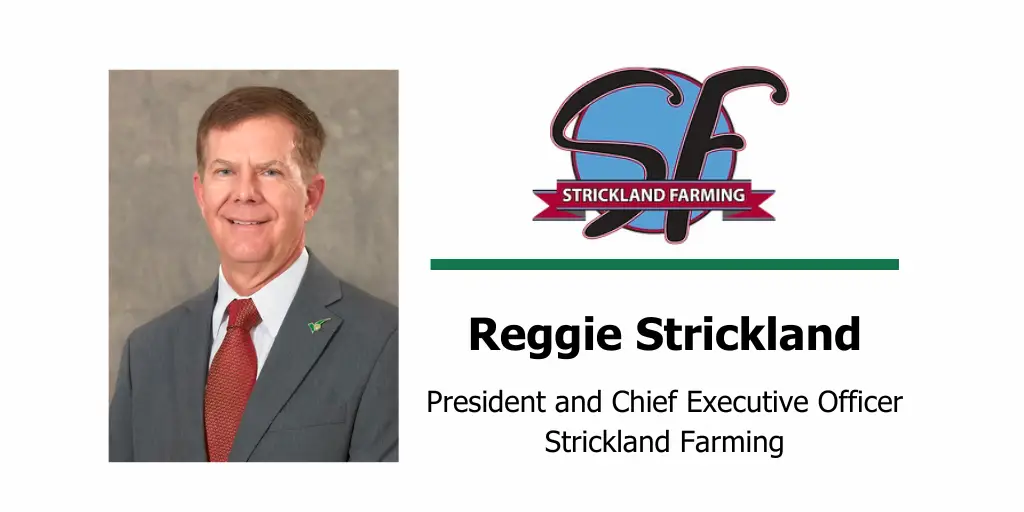
Recently, Golden LEAF President and Chief Executive Officer Scott T. Hamilton sat down with Reggie Strickland, president and Chief Executive Officer of Strickland Farming and a participant in the NC Ag Leads strategic planning process, via Zoom and filmed an episode of Critical Conversations. In this series, Scott talks with professionals about economic development issues affecting the state.
Strickland is a seventh-generation farmer in North Carolina.
He was a graduate of NC State University with a degree in agribusiness management. He also gained additional training through the Philip Morris Ag Leadership Development Program and the Executive Program for agricultural producers at Texas A&M. He serves on several different boards, including the NC Pork Council, the NC State University Board, and the United Soybean Board.
Strickland Farming operates in Sampson, Wayne, and Duplin Counties, producing corn, soybeans, sweet potatoes, and cucumbers. The operation also raises turkeys for Butterball and swine for Prestige Farms. He noted that the eighth generation is active on the farm, with his daughter having returned full-time in January 2024.
Looking ahead, Strickland said he is focused on the future of agriculture across North Carolina, including how the industry could prosper, remain profitable, and stay attractive to the next generation. He sees value in bringing together people who share this vision. Through his involvement with NC Ag Leads, he said this work helped connect agriculture with the research and innovation occurring at RTP, NC State University, and the Plant Sciences Initiative. With these resources, he said, it was an ideal time to unite leaders and explore what could be done to ensure that agriculture continued to thrive in North Carolina.
Strickland emphasized profitability as the key factor in drawing future generations back to farming. He added that although sustainability was important, he stressed that sustainability was impossible without profitability. He noted that agriculture had struggled with this for generations and cited data showing that the industry was only profitable two out of every ten years. No other industry, he added, could survive under such conditions. This financial strain made it difficult to encourage young people to return to the farm.
He shared how this challenge became personal when his daughter began talking about returning to the farm five years earlier. He wrestled with whether he wanted his children to face the same financial pressures that farmers experienced at the time. While he acknowledged that every job was stressful, he shared it should not have been as hard as it was to make a profit in agriculture, especially considering the essential work that farmers did in feeding and clothing the world. He said the industry needed to find ways to improve profitability moving forward.
Strickland shared that although his daughter, Savannah, had not grown up on the farm, he found it meaningful that she chose to come back. He and his family had lived about ten miles from the farm operation and office, an intentional decision on his part. Strickland had always set one clear expectation for his children: if they ever decided they wanted a future in the farming operation, they needed to work somewhere else first. He wanted them to gain experience, see the broader world, and develop knowledge beyond the farm before returning.
After graduating from NC State with a bachelor’s degree in Agricultural Business Management and minors in Spanish and Economics, Savannah went to work with the USDA, Strickland shared. She worked there for several years, and he said that experience helped shape her passion for agriculture. She enjoyed working with farmers every day and that work led to a deeper understanding of the work her family does at home. That exposure deepened her interest and inspired her desire to return. He added that she officially came back to the farm in January 2024. She manages marketing, handles employee training, and oversees Good Agricultural Practices (GAP) for their sweet potato operation. She also manages FSA work and supports multiple administrative and compliance tasks.
Strickland also recognized that some factors shaping agriculture’s future lay beyond farmers’ control, such as weather; however, he believes that through effective policy, strong leadership, and strategic planning, like the NC Ag Leads initiative, North Carolina can remain competitive nationally and globally. He points to North Carolina’s diversity as one of its greatest strengths. His own operation reflects the typical mix found in southeastern North Carolina, including livestock, row crops, vegetables, and specialty crops. He thinks this diversity, combined with the state’s advantageous geography and access to ports, positions North Carolina to continue playing a major role in feeding and clothing people around the world.
Strickland expressed appreciation for the work being done to support agriculture in the state, noting the importance of bringing together people both inside and outside the industry who have an interest in agriculture’s future. He said he values the commitment to building a sustainable and profitable path forward for North Carolina farmers and believes this work is essential for long-term success.
Learn more about Strickland Farming and the NC Ag Leads strategic planning process.