

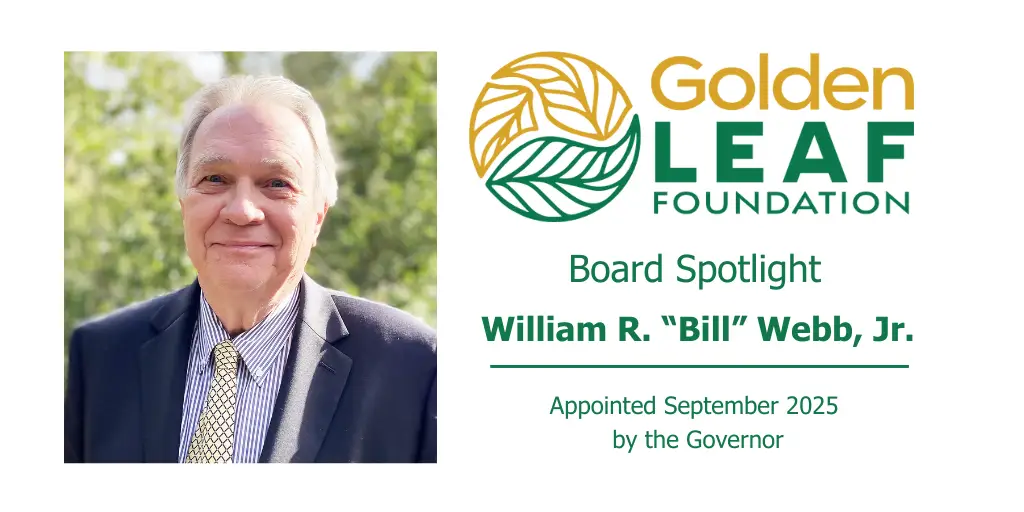
Name: William R. “Bill” Webb, Jr.
City of Residence: Ellerbe, NC
County of Residence: Richmond County
Employed by: Van Camp, Meacham and Newman PLLC
Appointed by: Governor
Appointment Date: September 2025
What are activities or leadership roles you provide for the community/state?
I have been fortunate to serve in several leadership roles at both the state and community levels. In 2024, I received the Order of the Long Leaf Pine, North Carolina’s highest civilian honor, in recognition of service to the state. In 2025, I was elected Chairman of the North Carolina Rural Infrastructure Authority after serving on its board since 2018.
My work in conservation and outdoor recreation has also been an important part of my community involvement. I served on the National Board of Directors for Pheasants Forever and Quail Forever from 2015 to 2017. The Webb Farm has been recognized for its conservation leadership, including being named the 2018 National Hunting Lodge of the Year by Sporting Classics Magazine, receiving the Governor’s Conservation Award for Business Conservationist of the Year in 2013, and earlier being honored as the 2004 Lawrence G. Diedrick Small Game Conservationist of the Year by the North Carolina Wildlife Resources Commission.
Locally, I previously served as Chairman of the Richmond Economic Partnership, which led economic development efforts for Richmond County for several years. These roles reflect my long-standing commitment to strengthening rural communities and supporting responsible natural resource stewardship.
What is your connection to rural, tobacco-dependent or economically distressed areas?
I am a lifelong resident of Richmond County and still live on my family’s farm, which has been in our family for six generations. I grew up working in tobacco and understand firsthand the significance of agriculture, and the impact of the loss of the tobacco industry on rural communities.
When the tobacco program ended in the late 1990s, we had to rethink how to sustain our 1,300-acre farm. Our family had always enjoyed quail hunting, so we decided to build on that heritage and develop an upland hunting lodge focused on outdoor recreation. Today, it is a boutique, 10-bed lodge that attracts guests from across the country and around the world.
That experience strengthened my belief that rural economic development requires finding ways to bring investment from urban areas into rural communities. Outdoor recreation is one of the strategies we have used successfully on our farm.
How does your personal and/or professional life complement Golden LEAF’s mission and priorities?
My background aligns closely with Golden LEAF’s mission to increase economic opportunity in rural and economically distressed communities. In the late 1990s, I served as chair of the private economic development venture in Richmond County, where I learned the fundamentals—and challenges—of economic development in a rural setting.
I later served as the Richmond County Attorney, which deepened my understanding of local government, business needs, and the importance of strategic investments in infrastructure and workforce. As an attorney, I have worked closely with the business community, giving me insight into what drives growth and what rural communities need to remain competitive.
I also believe strongly in leveraging each rural community’s unique strengths rather than trying to replicate what larger counties can offer. That perspective fits well with Golden LEAF’s approach to supporting locally driven solutions.
What are you most excited about happening in economic development in rural NC in the next 5-10 years?
In my role as Chair of the North Carolina Rural Infrastructure Authority, I’ve seen firsthand the strong pipeline of projects supporting job creation across the state. I’m seeing how Golden LEAF is also working on projects that support job creation and economic investment, workforce development, and agricultural advancements.
I’m seeing significant interest from companies across the country and internationally, driven by North Carolina’s business climate, strong infrastructure, and skilled workforce. Over the next decade, I expect that momentum to continue, with many industries choosing rural North Carolina for expansion or relocation.
What do you want people to know about the Golden LEAF Foundation?
Golden LEAF is deeply committed to supporting the communities most affected by the loss of the tobacco industry. The Board takes that mission seriously and works diligently to ensure funding is used responsibly and effectively.
In my time on the Board, I have been extremely impressed by the level of fiscal oversight and the care taken in evaluating each investment. The Board members are excellent stewards of the Foundation’s resources, and their commitment to Golden LEAF’s mission is evident in every discussion and decision.