
www.goldenleaf.org
Golden LEAF Rural Broadband Initiative receives Federal backing
Project will provide high-speed broadband to 69 North Carolina counties
MCNC was recently awarded $75.75 million in federal funding in Round Two of the Broadband Technology Opportunities Program (BTOP2) to support the Golden LEAF Rural Broadband Initiative.
The Golden LEAF Foundation Board of Directors awarded $24 million in matching funds for the BTOP2 grant, which was made possible through the American Recovery and Reinvestment Act Broadband Recovery Funds and funded through the National Telecommunications and Information Administration. An additional $5.25 million in match was also raised for the federal grant application from private sources.
The Golden LEAF Rural Broadband Initiative will enhance the existing North Carolina Research and Education Network (NCREN), which MCNC has operated for the last quarter century, and will add to the existing ERC Broadband Network operated by the non-profit ERC Broadband in western North Carolina.
The Golden LEAF Rural Broadband Initiative will build approximately 1,300 miles of new, middle-mile fiber throughout the state. In addition, about 400 miles of existing fiber will be made available to support the Golden LEAF Rural Broadband Initiative through lease agreements and donations. The Initiative traverses a total of 69 counties in rural northeastern, north central, northwestern and south central North Carolina. Sixty-seven of these counties are designated as fully or partially underserved by broadband service.
"The areas of the state covered by the Golden LEAF Rural Broadband Initiative continue to transition their economies to compete globally," said Dan Gerlach, Golden LEAF President. "The Golden LEAF Foundation's Board of Directors viewed the investment in the Golden LEAF Rural Broadband Initiative as an opportunity to provide essential infrastructure, take advantage of federal matching dollars, and invest directly in efforts to grow stronger communities."
North Carolina Governor Bev Perdue congratulated MCNC and the Golden LEAF Foundation as well as commended U.S. Commerce Secretary Gary Locke and his team at the National Telecommunications and Information Administration for making this second middle-mile investment in North Carolina through the BTOP program.
"This investment provides North Carolina with a robust broadband infrastructure that will help deliver access to education, through NCREN, that is not defined geographically but is equitable for every student at every level of education," said Gov. Perdue. "This infrastructure also helps us scale to meet the health care needs of our most rural citizens, and levels the playing field in attracting high-paying jobs to rural North Carolina."
The Initiative will greatly increase the broadband capacity and stabilize bandwidth and Internet access costs for public school systems, community college campuses, libraries, universities, and other community anchor institutions that connect to NCREN. The high-speed connectivity will provide 4,066 community anchor institutions with fiber connections, including 1,718 K-12 schools, 61 community college main and satellite campuses, and 33 baccalaureate degree-granting, four-year colleges and universities. In addition, 254 public libraries, and 1,887 municipal, county and state public safety facilities will be served.
Many private-sector wholesalers and last-mile service providers have expressed interest to MCNC in leasing fiber resulting from the Golden LEAF Rural Broadband Initiative. More than a dozen letters of support and interest from private-sector service providers were included in the grant application. As a result, every region of the newly-funded fiber build will likely have private-sector partners who will increase the broadband service options for citizens and businesses in these areas.
The Golden LEAF Rural Broadband Initiative award builds on MCNC's Round One BTOP award, a $39.9 million project (including $28.2 million in BTOP Funds) granted in January 2010 to build 480 miles of fiber in 37 counties in southeastern and western N.C. The two broadband projects total more than $140 million.
For quotes from officials supporting the Golden LEAF Rural Broadband Initiative and further information about the project, read below.
U.S. Senator Kay Hagan--
"This second grant of $75.75 million to MCNC -- which is on top of $39.9 million awarded in January -- is a serious investment in broadband infrastructure for North Carolina. North Carolinians in the areas gaining this technology will now have 21st-century broadband infrastructure, which will boost job growth in our state. When this fiber is built, students in rural schools, community colleges and four-year colleges and universities will access a network that will meet their research and education needs well into the future. With this award, many more North Carolinians will have broadband access, and I will continue working in the senate to secure broadband funding for North Carolina."
Erskine Bowles, UNC President--
"This BTOP award is truly a game changer for North Carolina. Since 1999, the Rural Prosperity Task Force and our state's leaders have highlighted the importance of statewide access to broadband for our students and citizens. The funding of the Golden LEAF Rural Broadband Initiative is the most significant event toward meeting this goal since it was crafted over a decade ago. For the University system, an NCREN with a statewide fiber footprint will enable our institutions to accelerate the pace of innovation and research, educate greater numbers of students, and address the health care, education, and economic needs of North Carolina's citizens in greater numbers. NCREN truly is a digital pathway through which our public university can reach all citizens of the state."
Michael A. Murphy, chairman, MCNC Board of Directors--
"North Carolina has long supported affordable broadband networks to ensure a high quality of life and a globally-competitive future for its citizens, businesses, and communities. Securing second-round funding provides critical broadband infrastructure to areas of the state that without the BTOP program would likely never see this investment. We are pleased our application has been funded by the NTIA and are grateful that the Golden LEAF Foundation saw fit to invest into this project."
69 counties to receive fiber under the Golden LEAF Rural Broadband Initiative:
Alleghany, Anson, Ashe, Avery, Beaufort, Bertie, Brunswick, Buncombe, Cabarrus, Caldwell, Camden, Carteret, Caswell, Chatham, Chowan, Cleveland, Columbus, Craven, Cumberland, Currituck, Dare, Edgecombe, Franklin, Gaston, Gates, Graham, Granville, Halifax, Harnett, Haywood, Henderson, Hertford, Hyde, Jackson, Lee, Lincoln, Madison, Martin, McDowell, Mecklenburg, Mitchell, Moore, Nash, New Hanover, Northampton, Onslow, Pasquotank, Perquimans, Person, Pitt, Polk, Richmond, Robeson, Rockingham, Rutherford, Scotland, Stokes, Surry, Swain, Transylvania, Tyrrell, Union, Vance, Wake, Warren, Washington, Watauga, Wilson, and Yancey
To read more about the Golden LEAF Rural Broadband Initiative, click here.
|
Golden LEAF announces $4 million STEM Initiative
Foundation requesting proposals to get students career ready: Deadline for proposals September 7
The NC STEM Community Collaborative recently hosted the Golden LEAF Foundation to talk about the requirements of the newly formed Golden LEAF STEM Initiative.
The Golden LEAF Foundation is seeking proposals for a special $4 million initiative geared toward preparing North Carolina's youth for careers requiring science, technology, engineering and mathematics (STEM) compentencies. Organizations receiving funding under the Golden LEAF STEM Initiative can receive up to $750,000 for projects spanning a three-year period.
"The STEM Initiative is about creating a highly-skilled workforce, through educating our youth in core curriculum areas that are currently underrepresented and are needed to compete for available and emerging job markets in our state," said Dan Gerlach, Golden LEAF President. "The Foundation is interested in building the talent, knowledge and skill of North Carolinians so that we may find new ways to transition our economy."
The Initiative will focus on supporting successful models that increase STEM education for students in grades four through nine in rural, economically distressed and/or tobacco-dependent counties of North Carolina.
Priority will be given to projects that represent collaborative efforts aimed at preparing students to be college and/or career ready in disciplines that require strong STEM skills; have data demonstrating successful outcomes in student enrollment and achievement; represent collaborative arrangements among educational partners and industry targeting the current and future employment opportunities of a region or local area; and focus on rural, Tier One and Tier Two, and/or tobacco-dependent counties that currently have low concentrations of STEM programs.
Competitive proposals will target underrepresented minorities, females and limited-resource students. Applicants are encouraged to think regionally, draw connections to industry sectors, and align with outcome measures in college and career readiness, student achievement, participation and engagement, teacher effectiveness, and other economic impact measures. For a full list of priorities, click here.
Organizations must be a 501(c)(3) nonprofit or governmental entity, serve the people of North Carolina, and be a local education agency, university, community college or direct provider of training in order to be eligible to apply.
Letters of Inquiry are due September 7, 2010 and may be accessed by clicking here.
To listen to the conference call about the Golden LEAF STEM Initiative, click here.
If you have further questions about the STEM Initiative, contact Mark Sorrells, Golden LEAF Senior Vice President, at msorrells@goldenleaf.org or 888-684-8404.
Golden LEAF awards $500,000 grant as part of matching funds for federal i3 grant program
Grant award part of Golden LEAF STEM education strategy
The Golden LEAF Foundation recently awarded a $500,000 grant to the North Carolina Science, Mathematics, and Technology Education Center for its "i3 LASER Model in North Carolina" project.
The award was made under Golden LEAF's STEM education strategy, to take advantage of the opportunity to leverage federal Investing in Innovation (i3) grant funds by providing the needed matching dollars for North Carolina projects applying for these grants.
The "i3 LASER Model in North Carolina" project will support science education reform work in North Carolina and is part of the $1.5 million match needed to leverage $6 million in federal funds.
The LASER Model will be used by the NC Science, Mathematics, and Technology Education Center and the National Science Resource Center to provide a systemic approach to science education reform. The program will provide educational leadership development for school administrators, teachers, and corporate and community leaders. 1,000 North Carolina teachers will receive high-quality, content-specific professional development and research-based science education instructional materials to drive experiential, hands-on learning for the benefit of 25,000 of North Carolina's children.
|
|
Schools adding a new dimension to educational opportunity
BRAC Region recognized as one of NC's first STEM communities
The Base Realignment and Closure (BRAC) Region -- the 11 counties surrounding Fort Bragg and Pope Air Force Base -- is one of three areas in the state recognized as North Carolina's first STEM communities, thanks in part to a pilot technology project funded by the Golden LEAF Foundation.
Golden LEAF provided funding for 12 high schools in the BRAC Region to receive equipment and training for implementing an Enhanced Technology Classroom (ETC). The grant provided each ETC at the schools with a portable and fixed i3D theater, SMART board, video telepresence, HD cameras, and connectivity with a distributive learning network via the Internet.
This summer, seven of the school districts connected virtually, over the internet, to participate in a six-week internship to learn the basics of JavaScript, 3D modeling and 3D simulation. The students were led through the internship by Richmond County Schools Director of Information Technology, Jeffries Epps, and student intern, Grady Lorenzo.
"The summer internship was designed to get students armed with the basics of using the 3D technology," said Epps.
Epps explained that in the upcoming year, each of the schools will pair the interns with industry partners that work in the student's field of interest. Students will then be able to design 3D models for industry, gaining a more in-depth understanding of their core area of interest and taking a first step toward securing a career.
Teachers, faculty and students in the BRAC Region are now collaborating across school districts to find innovative ways to use the new technology. The Region is building teams of educators and students with similar interests in technology and creating a shared repository for all teachers to use the technology as a tool in the classroom.
Each of the school districts has taken a slightly different approach to implementing the technology project in their schools, which makes collaboration between schools on sharing materials and best practices even more essential. However, all of the schools are finding students interested in getting hands-on technology experience.
Richmond County Schools
Epps' approach has been to let the students lead the direction of the program. He decided to create a pilot program using student interns. On his recruiting mission, he was directed to Grady Lorenzo, a tenth grader with a great aptitude for technology.

Pictured are (from left) Jeffries Epps, Richmond County Schools Director of Information Technology, and Grady Lorenzo, student intern.
According to Epps, Lorenzo has been a strong leader for the direction of the program and has helped recruit other students from several of the schools in the region to be a part of the technology community.
Lorenzo's personal accomplishments include developing and designing a video game that Richmond Senior High students play on a regular basis and several other games designed for educational instruction. He has become an instructor for both new interns and teachers. He creates programs and simulations for lesson plans for teachers wanting to use the i3D technology throughout the BRAC Region. Lorenzo and two other Richmond interns, Miles Pattan and Ryan Hudson, created a 3D training module for GE out of Durham for one of their jet engines. Lorenzo has served as senior designer on several group projects and served as senior designer and facilitator for the six-week summer internship.
"After graduating, Grady plans to land a job as a 3D designer for video games, an industry that will pay between $40,000 and $80,000 to start," said Epps. "He will have a resume and skill set that most coming out of college won't have. His technical skills along with his project management expertise will be attractive to employers in the serious gaming industry."
Montgomery County Schools
Graham Fox, Director of Career and Technical Education at Montgomery County Schools, decided that one school in his district having equipment wasn't the way for his program to go. He has taken his stationary equipment and mobile unit and divided it between both the high schools in the county: East and West Montgomery High Schools.
The result was that ten students, five from East Montgomery and five from West Montgomery, have formed teams to work on interactive 3D models targeting math and career and technical curricula at their schools. The teams are working on models for teachers to include in their lessons. The goal is to make learning more tangible and connected to the technology level that excites student learning.

Pictured are students from East and West Montgomery High Schools working together on the 2010 summer internship hosted by Richmond County Schools.
According to Fox, the two rival high schools have even joined forces to write a business plan for a grant to enhance the scientific and technical visualization course taught at the schools.
The students who are working on the technology teams have a good idea of how important learning these new skills can be for their future careers. Montgomery students in the program have declared interests in jobs such as designing video games, architecture, engineering and medicine.
Other BRAC schools
Several of the other participating BRAC schools have formed student "innovation teams", created i3D learning objects, connected students with industry and economic development leaders, introduced the technical capabilities into existing classrooms, used technology to create activities to engage and motivate students, and created websites to share ideas and lessons with other instructors and students. Each of the schools is working to expand their programs for the shared goals of increasing educational attainment, raising the level of employment and income levels, and collaborating with local employers on student internship opportunities in STEM-related fields.
Click here to see video of students participating in the six-week iD3 summer internship. |
Questions about Golden LEAF?
Please contact Mark Sorrells at msorrells@goldenleaf.org.
Comments or feedback about our newsletter?
Please contact Jenny Tinklepaugh at jtinklepaugh@goldenleaf.org.
© 2011 Golden LEAF Foundation, Inc. All rights reserved. |
Message from the President
|
Through a hot summer and uncertain economy, the Golden LEAF Foundation remains singularly focused on the efficient and effective use of its funds to transform North Carolina. In this issue of LEAF Lines, you'll read about MCNC's successful bid to win $76 million in federal broadband grants that combined with $24 million in support from Golden LEAF will provide middle-mile infrastructure to education and other institutions in 69 North Carolina counties, covering almost 1,300 miles of fiber. This Golden LEAF Rural Broadband Initiative will provide levels of service that would not otherwise be found for years in some of the most remote areas of North Carolina.
You'll also read about our other efforts to provide leverage to federal funding opportunities, like in our grant to the North Carolina Science, Mathematics, and Technology Education Center to provide cutting-edge science education, professional development and equipment to 1,000 teachers and 25,000 schoolchildren in seven rural counties. This is our initial grant in a broader initiative around science, technology, engineering and math (STEM) education. Applications for that program are due September 7.
We are evaluating the progress of Golden LEAF Opportunities for Workers (GLOW) grants made to 22 North Carolina community colleges. These grants, made one year ago, were targeted at short-term job training to help North Carolinians get trained for jobs currently open. This issue highlights the efforts of Cleveland Community College and provides examples of how we hoped the program might work.
Our work in Tier One counties continues. Read about Caswell County's initiative for collaboration between a high school and community college as an example of our Community Assistance Initiative (CAI) work. Education, workforce and economic development are major items of focus in many counties. We expect to award CAI grants in October to organizations in Bladen and Martin counties, and work continues in Graham, Greene, Mitchell, Montgomery, Tyrrell, and Rockingham counties.
Jobs remain priority one with the Foundation. Since I last wrote, we've played a role in helping Clearwater Paper come to Cleveland County and Caterpillar commit to expand operations in Lee County and build a new plant in Forsyth County. In recent weeks, we have seen an uptick in opportunities to help with economic development, and this momentum gives us hope. I look forward to updating you with more successful grants in this regard.
Just as we're helping land hundreds of jobs through our support, we're also helping small businesses gain access to capital. A $5 million grant to Self-Help will leverage an estimated $25 million in loans. Click here for more information.
Please let us know how we can continue to work with you for the betterment of North Carolina.
Dan Gerlach can be contacted by e-mail at dgerlach@goldenleaf.org. |
Golden LEAF Opportunities for Work (GLOW) grants fund lifesaving programs
Cleveland Community College training certified nursing assistants and firefighters for available jobs
Through the Golden LEAF Opportunities for Work (GLOW) initiative, two Cleveland Community College (CCC) programs are graduating more trainees in less time and accelerating efforts to put people back to work during a down economy. Both of the programs are training people for careers that save lives.
CNA Program
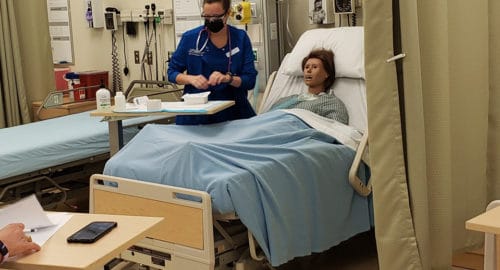
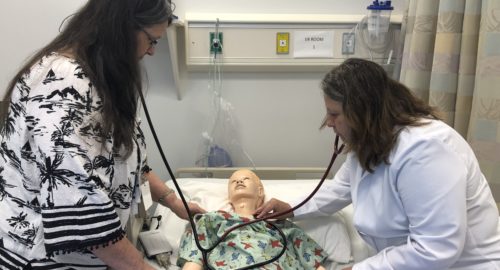
The Golden LEAF Foundation awarded CCC a $110,000 GLOW grant to provide the Certified Nursing Assistant (CNA) program with additional patient simulators and equipment to help increase the capacity and student throughput of the program. The simulators, quickly becoming a norm in training health professionals, provide instructors with immediate and accurate feedback on student performance in clinical experiences.

Pictured is the CCC patient simulator lab.
Enrollment has increased by 41% from the Spring of 2009 to the Spring of 2010 in the CNA program. Since receiving Golden LEAF funds, the college reports that health service employers have hired 166 certified nursing assistants out of the 210 trained at CCC. Other CNA students have continued on to complete Licensed Practical Nurse (LPN) and Associates Degree in Nursing (ADN) programs.
One of the students participating in the CNA program has been especially grateful for the opportunity to learn specialized skills for the purpose of serving others.

Dorothy Williamson, CCC CNA graduate
Dorothy Williamson lost her job when a plant she worked at for 21 years laid off over half of its employees. She quickly decided that she needed to have training so that she could be marketable when seeking employment. She also wanted to work in a job where she could help people.
Although she had trepidation about attending school after being out so long, she decided to enroll in CCC's CNA program.
Williamson said that the Golden LEAF-funded equipment helped her train for possible real-life scenarios before going out to face them.
Williamson finished her CNA I class and then continued on to finish the CNA II program. She is now working part-time as a CNA and plans to go back to CCC to enhance her employability by getting her Phlebotomy Certificate.
Although, Williamson says she needs the money to "better her financial situation," she isn't in this field for the paycheck.
"I was devastated when I was laid off," said Williamson. "Being a CNA provides me with a sense of purpose and makes me feel like I am able to offer something back to society."
"Pay is not why I'm doing it," said Williamson. "I have a love for people. I want the elderly to know that there is someone to care for them."
Firefighter I/II & Hazmat Academy
CCC also received a $215,000 GLOW award for its "Firefighter I/II & Hazmat Academy" program.
The Academy combines a total of 20 training courses into one academy that graduates job-ready trainees in two months versus the previous two-year program. Trainees are able to finish their training with both the Firefighter I/II and NC Hazardous Materials certifications.
The Golden LEAF Foundation provided funding through its GLOW program to purchase equipment that is proving beneficial to students and individuals already employed in fire safety.
"Without the funding Golden LEAF provided for equipment, CCC could still have an academy, but it would not be even close to the same level of programming we have now," said Jimmy Hensley CCC's Emergency Training Center Coordinator. "We are extremely grateful for Golden LEAF's support."

This CCC Firefighter I/II & Hazmat Academy student is dousing a simulated house fire.
CCC's Firefighter I/II & Hazmat Academy is unique in North Carolina because of its open enrollment process. So far, the college has produced over 70 trained firefighters in three academies.
According to Hensley, "The program not only cuts down the driving time to attend classes and the number of years it takes to finish them, but also the Academy provides graduates with a level of merit because they participated in an 'academy'."
The Shelby Fire Department is so impressed by the Firefighter I/II & Hazmat Academy that it has agreed to only hire firefighters trained by the CCC Academy.
Forty-five of the graduates have or are in the process of becoming employed as full-time firefighters. The hiring process can take a year or more before a firefighter is considered a full-time employee. Many of the remaining Academy students have continued their education by enrolling in the Emergency Medical Technician training program, which is a requirement for many fire departments.

Pictured are CCC Firefighter I/II & Hazmat Academy students working to control a simulated car fire.
About the GLOW Initiative
GLOW was created to address some of the urgent job training needs North Carolina faces during the current economic downturn. It was a short-term, non-degree workforce development grant initiative that supported vocational and/or technical training programs targeting identified employment opportunities in tobacco-dependent, economically distressed and/or rural communities. The expected outcome of projects awarded under this initiative is the eligibility of trainees for placement in permanent, full-time jobs requiring their new skills.
Golden LEAF awarded $3.5 million in funding to 23 projects ranging from Shelby in the west to Elizabeth City in the east. Priority was given to projects that will have a positive effect on tobacco-dependent, economically distressed and/or rural communities that demonstrated strong demand for trainees. |
County schools and community college in Caswell County join forces for job training
Caswell citizens choose education and workforce/ economic development as priority for Golden LEAF funding
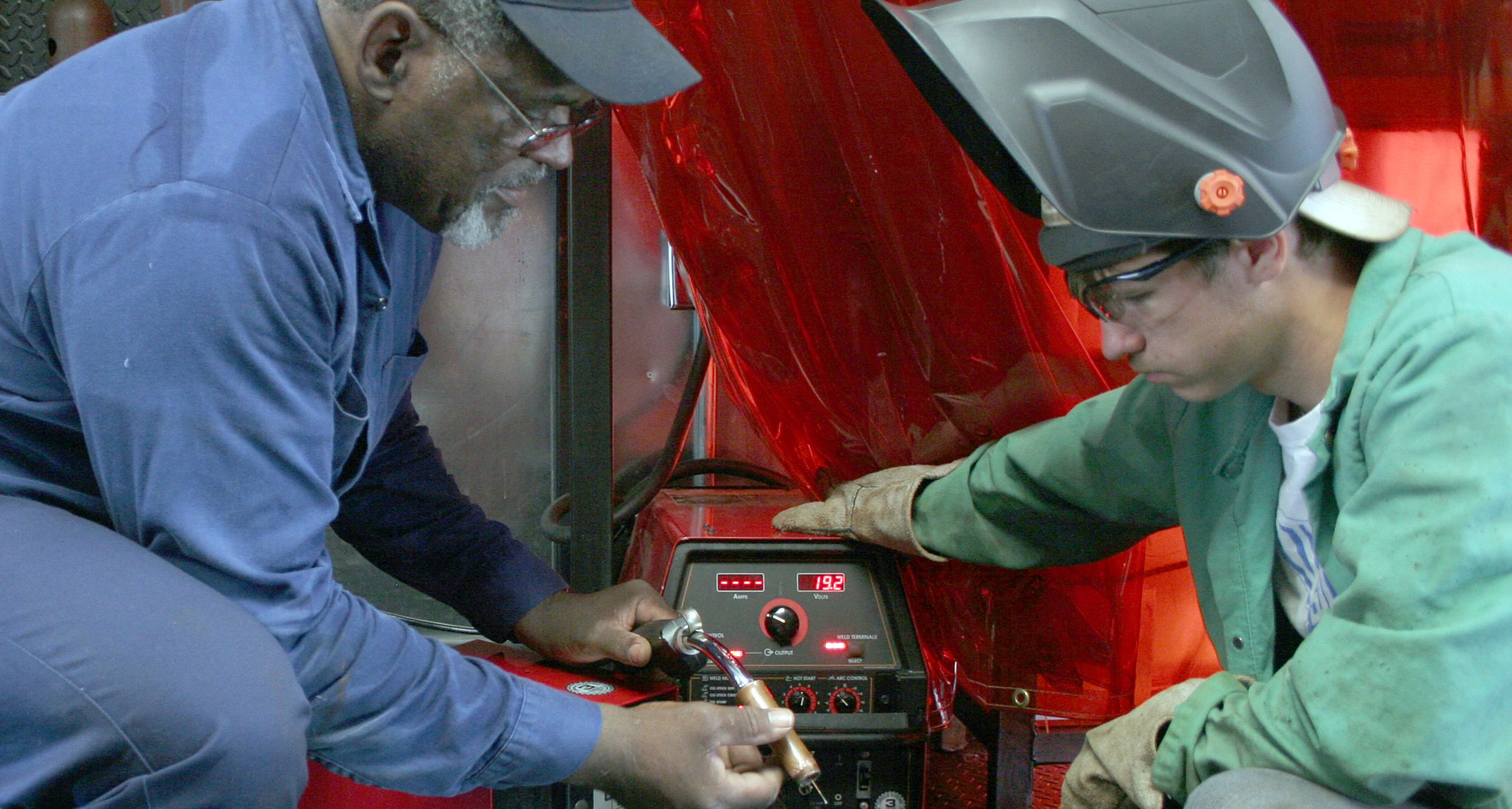
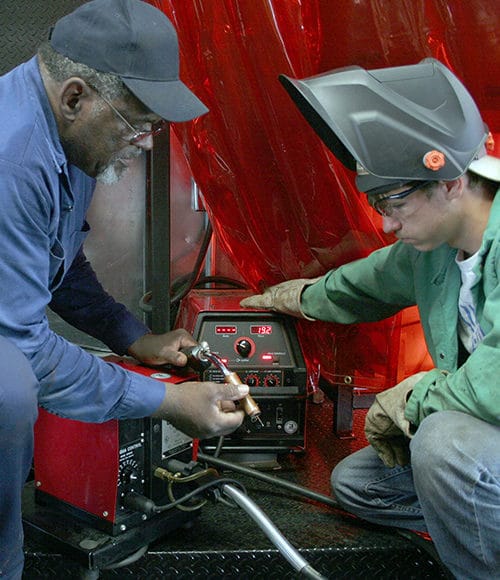
Welding students from Bartlett Yancey High School and Piedmont Community College will start the 2010-2011 school year in a new, state-of-the-art, 4,800-square-foot training facility, thanks in part to a Golden LEAF Community Assistance Initiative grant.
The Golden LEAF Foundation awarded Caswell County Schools $580,000 to construct a workforce training facility to be shared with Piedmont Community College that features three classrooms and a welding lab. The project will help prepare high school and community college students with the skills needed to gain employment in the lucrative field of welding.

Dr. Douglas Barker (left) talks with Dan Gerlach about the importance of the Golden LEAF grant to the community.
"We would have never been able to build the training facility without Golden LEAF support," said Dr. Douglas Barker, superintendent of Caswell County Schools. "Now, our students will have an outstanding environment to work in."
Several nearby companies are in need of workers with the technical skills that welding training provides. Nationwide, the welding profession is estimated to be short by around 150,000 workers.

Because Golden LEAF provided funding for the facility, Piedmont Community College was able to contribute upgraded equipment in the welding lab.
"Employment is a challenge in our community," said Piedmont Community College President, Dr. Walter Bartlett. "This opportunity fills a big need in our community for advanced technical skills training."
The college and Bartlett Yancey High School campuses are located side-by-side. And, although the new training facility is located on the high school campus, the project is a true collaborative effort. Classes will be taught by college instructors and high school and college students will both be trained under the same roof.
While students are signing up for Fall 2010 semester classes, Mike Dossett, Vice President of Instruction and Student Development at the college, reports that enrollment is increasing in the welding classes. Part of the increase is a result of the increased physical capacity of the classroom. In the 2007-2008 school year, 84 students were unable to take welding classes because of facility limitations. The schools anticipate providing training to approximately 270 students a year.
The workforce training facility project addresses three of the goals identified by Caswell County Citizens participating in the Golden LEAF Community Assistance Initiative meetings: k-12 education, workforce development and economic development. Overall, four projects from organizations in the county were awarded CAI grants totaling just over $2 million for broadband infrastructure planning, education and workforce training, value-added agricultural products and infrastructure improvements to attract business and industry. |
|